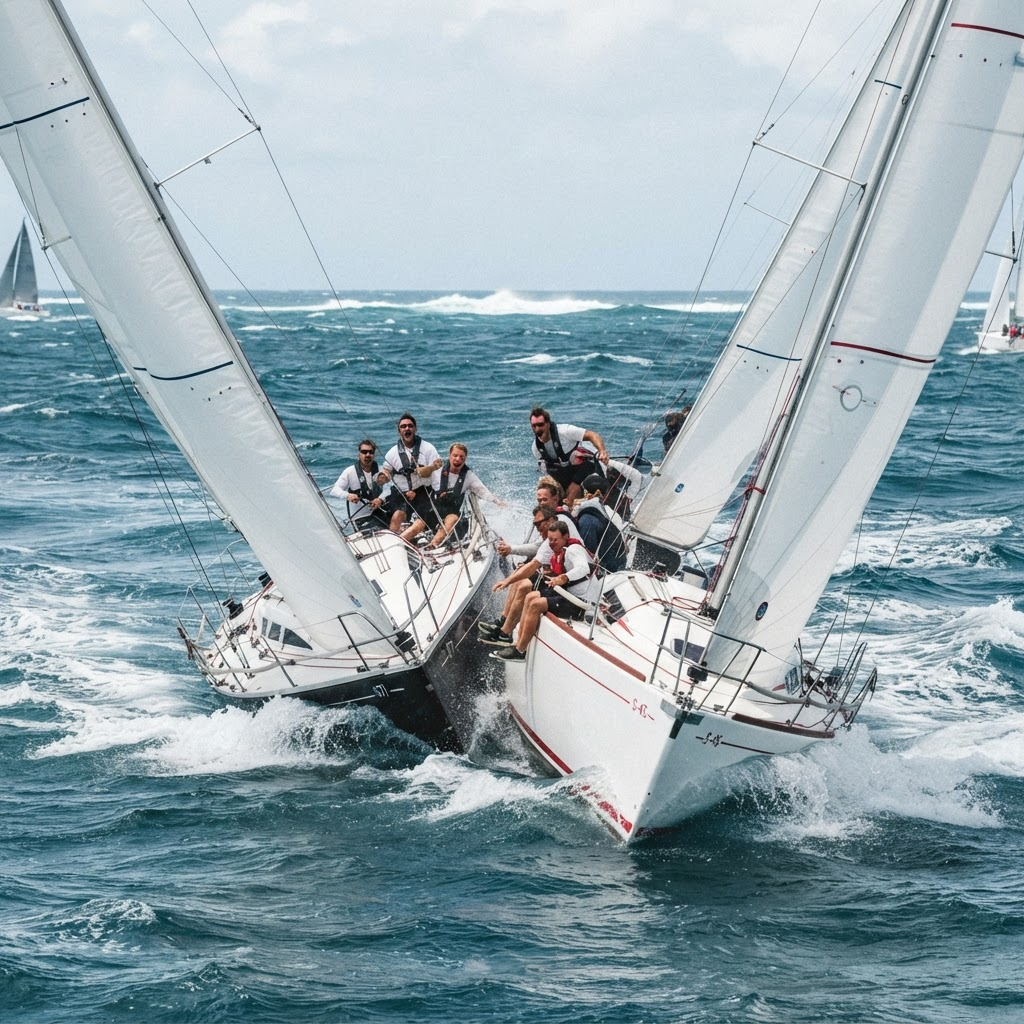
World Sailing's Racing Rules run to dozens of pages. But five core rules cover 90% of on-water situations. Know these, and you race with confidence.
The Racing Rules of Sailing are published by World Sailing and updated every four years. They are comprehensive by necessity — sailing happens in three dimensions at speed — but in practice, most situations are governed by a handful of core principles.
Port–starboard (Rule 10)
A boat on port tack must keep clear of a boat on starboard tack. This is the most fundamental right-of-way rule. When in doubt, the safest action is to tack onto starboard or duck behind the starboard-tack boat.
Windward–leeward (Rule 11)
When two boats are on the same tack and overlapped, the windward boat must keep clear of the leeward boat. The leeward boat may luff, but must give the windward boat room and time to respond.
Mark-room (Rule 18)
At a rounding mark, a boat on the inside of an overlap at the "zone" (three hull lengths from the mark) is entitled to mark-room. The outside boat must give sufficient space to round in a seamanlike manner. The zone begins the moment the leading boat's bow enters the three-length circle.
Room to tack (Rule 20)
When a boat needs to tack to avoid an obstruction (typically the shore or another vessel) it may hail "water" or "room to tack" to a boat to windward. The hailed boat must either tack immediately or respond "you tack" — but cannot refuse.
Penalties
Infringing a right-of-way rule typically requires a two-turn penalty: the infringing boat makes two 360-degree circles before continuing. Taking the penalty voluntarily and promptly is always quicker than a protest hearing and its consequences.