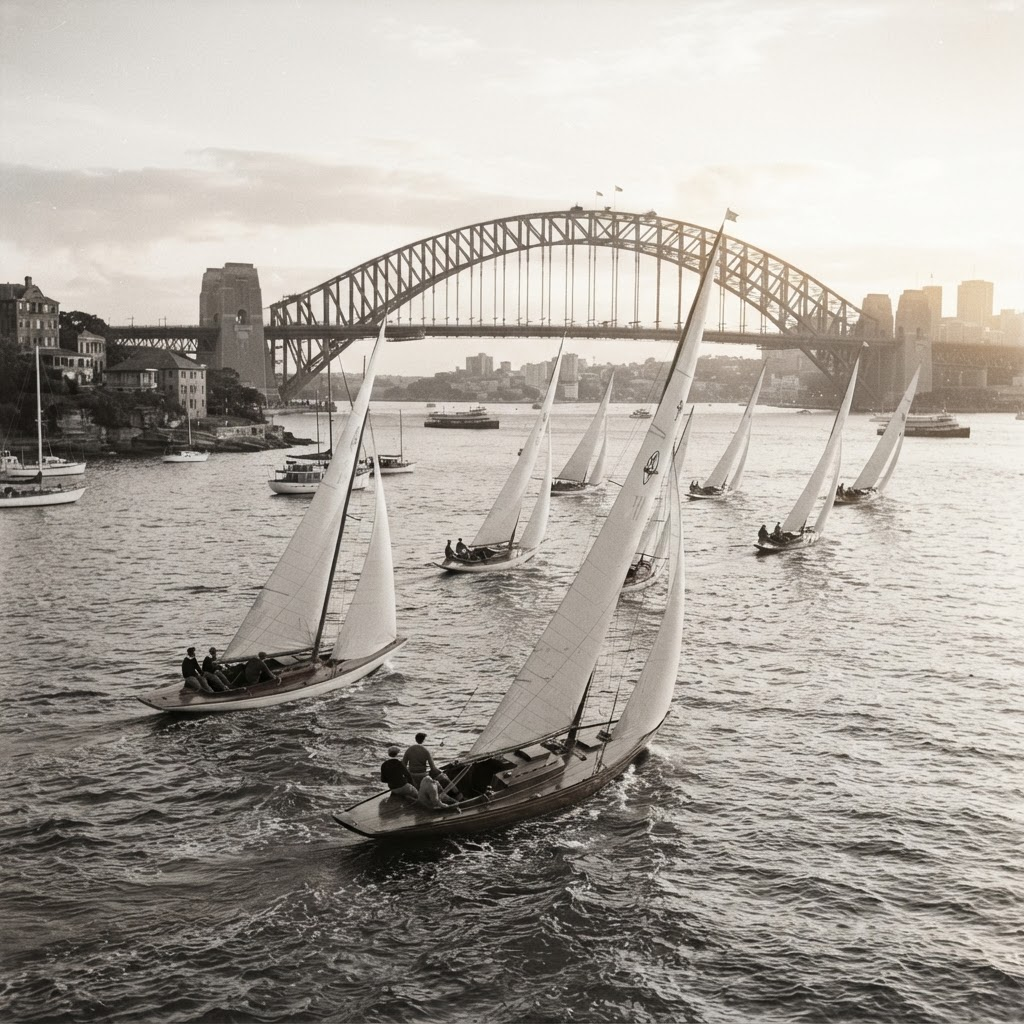
From the earliest colonial regattas to Sydney Harbour icons and world championship victories, Australian sailing has a story that spans centuries.
Australia's relationship with the sea is inseparable from its identity. A continent whose largest cities face the ocean, whose settlers arrived by sail, and whose climate invites year-round racing — it was inevitable that sailing would become deeply embedded in the national character.
The colonial era
The first recorded regatta in Australia was held on Sydney Harbour in 1827. The event was a social spectacle as much as a competition, attracting wealthy colonists and naval officers who brought with them the sporting traditions of Britain. Wooden craft raced around marks set in the harbour, watched by crowds on the shore.
By the mid-19th century, yacht clubs were being established across the continent. Each club developed its own class preferences and handicap systems, reflecting the geography of its home waters.
The rise of competitive racing
The late 19th century saw the establishment of more formalised racing. A national championship structure emerged in the 1900s, and Australian sailors began competing internationally. Offshore racing grew rapidly after World War II, with long-distance races capturing public imagination.
International breakthroughs
Australian sailors achieved breakthrough international results through the latter decades of the 20th century. The country developed a reputation for producing technically skilled, tactically aggressive sailors who excelled across a range of conditions — from the light airs of sheltered bays to the heavy sea states of offshore courses.
Contemporary excellence
Today Australian sailors compete at the highest levels across all sailing disciplines — from Olympic classes to offshore racing to match racing. A network of clubs, training programmes, and high-performance pathways supports the development of talent from junior level through to the elite.